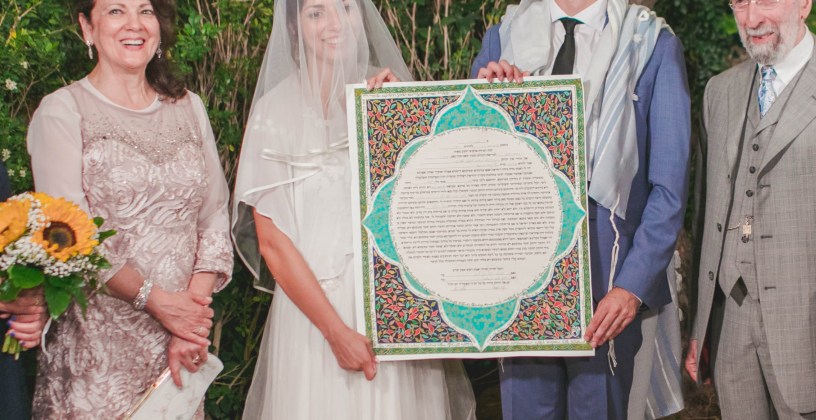
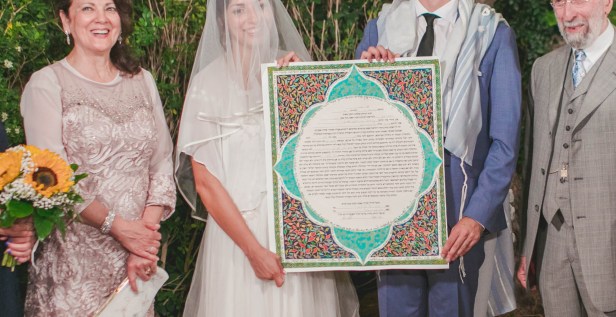
The Ketubah (כתובה) is the Jewish marriage contract. Essentially, it is a contract outlining the husband’s responsibilities and obligations to his wife.
The traditional Ketubah is not romantic and not equivalent to the Western vows “to have, to hold, to cherish” – rather, it serves as a legal document, containing the names of the bride and the groom and their fathers’ names, the location and date of the wedding, the marital history of the bride, the signatures of two witnesses, and the monetary amount of “severance pay” that the husband owes the wife in the event of divorce.
Since the Ketubah is a legal document, it’s critical that all the information is accurate and that there are no mistakes in order to make sure that the marriage is halachically valid. You should consult with your Rabbi if you have any questions.
Ketubah Text
Here’s an excerpt (translated to English) of the Ketubah text used by the Rabbinute:
“On the ___ day of the week, the ___ day of the [Hebrew] month of ___, the year ___ after the creation of the world, according to the manner in which we count [dates] here in [location], the groom ___ son of ___ said to this [bride’s name] daughter of ___, “Be my wife according to the law of Moses and Israel. I will work, honor, feed and support you in the custom of Jewish men, who work, honor, feed, and support their wives faithfully. I will give you the settlement of ___ silver zuzim [silver coins], which is due you according to ___ law, as well as your food, clothing, necessities of life, and conjugal needs, according to the universal custom.”
For a full English translation of Orthodox Ketubah text, you can see here.
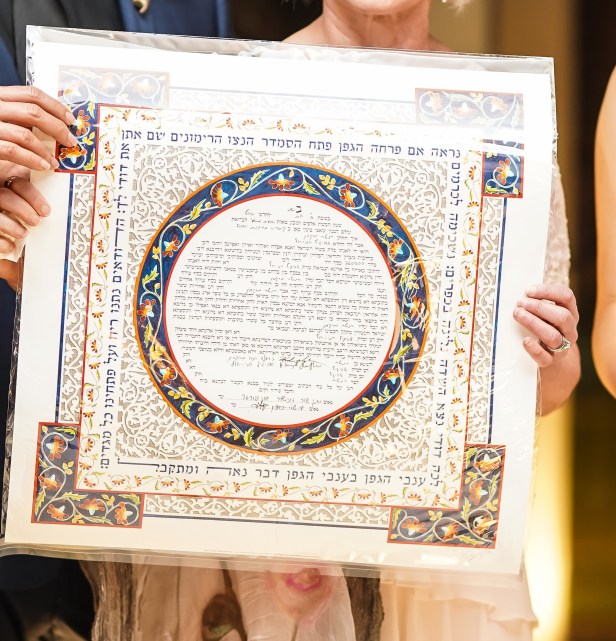
Alternative Ketubah Text
There are standard texts used for each denomination of Judaism: Orthodox, Conservative, and Reform.
The Conservative and Reform texts contain variations in the text itself, as well as additional clauses.
For further information, please consult with your rabbi. Examples of variations of Ketubah text by denomination can be found here.
You can also create a Ketubah with your own custom text, personal to you, that outlines the commitments you and your beloved are making to each other.
Examples and inspiration for alternative Ketubah texts can be found here.
Who Signs the Ketubah?
If you are getting married through the Rabbbinute, the Ketubah will be signed by the groom and two witnesses. In some cases, there can also be a line for the Rabbi who performed the ceremony to sign.
Conservative and Reform rabbis permit the bride to sign the Ketubah as well.
Who Can Be A Witness?
If you are getting married through the Rabbinute, your witnesses must be two observant (Shomer Shabbat) adult Jewish men.
The witnesses are not allowed to be a close blood relative of either the bride or groom, so no fathers or brothers of the couple. Distant relatives and friends typically sign the Ketubah, and it’s considered a huge honor to be asked to do so.
Conservative and Reform Jews accept adult Jewish women as valid witnesses. If you are having an alternative ceremony with a non-Rabbinical officiant, the witnesses are up to you, regardless of gender or faith.

Ketubah Design
If you are getting married through the Rabbinute, you will receive a standard Ketubah once you open your Tik Nissuin (Marriage File.)
However, you can swap that out for a custom designed Ketubah that’s suited to your personal aesthetic – you just need to make sure that the text within is halachically valid. I highly recommend that you double-check the text to be used with your Rabbi before the artist creates the Ketubah.
Prices for a custom Ketubah range wildly, depending on the size, materials used, and demand for the Ketubah artist. Like all art, you can find a Ketubah for cheap or luxury level prices.
I’d say a good starting point for a printed Ketubah with a design (not done by hand) would be somewhere around 1500 – 2000 shekels. For a handmade, custom creation, you can expect to pay 3000 shekels and up.
Today, there are many talented Ketubah artists creating beautiful designs and you can find the style that appeals to you most by browsing their sites and social media.
For my Ketubah, I used Rachelle of The Delicate Brush. We received tons of compliments on it, even from our Rabbi!
 The Israeli Wedding