I’m (very) biased and will admit that I absolutely love the elements of a Jewish wedding.
From the Sheva Brachot (7 Blessings) to breaking the glass, there are so many moving aspects of a Jewish ceremony that have withstood the test of time for thousands of years – and I believe the reason for that is because they are incredibly meaningful.
For a couple wanting an alternative ceremony, I think that tweaking the fundamentals, in order to craft a ceremony to fit your needs and personal values, is the best strategy.
If there are particular aspects of the Jewish ceremony that don’t align with your beliefs, you should skip them – but keeping and adapting some of the basics to pay homage to your roots, is a great way to creating a moving ceremony that’s personal to you but still connected to your heritage.
Of course, if you’re envisioning a totally alternative ceremony where you each ride in on a white horse, then light a unity candle together – more power to you!
But generally speaking, wedding planning is chaotic enough without trying to reinvent the wheel for the ceremony itself. Try using elements of the classic Jewish wedding as a starting point and modify wherever you feel it’s necessary.
For more information on alternative officiants, see here.
I highly recommend that you check out this page from the Israel Movement for Reform and Progressive Judaism, as they have an extensive breakdown of how to adapt the traditional Jewish ceremony to better fit your values.
Sheva Brachot (7 Blessings)
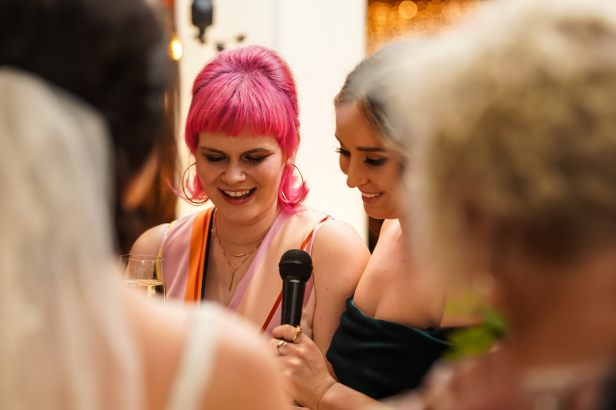
In a traditional Jewish wedding, the Sheva Brachot are read by adult Jewish males. However, if you are having a ceremony customized to you, this is the perfect opportunity to invite up your loved ones and include them in the ceremony, regardless of gender or religious background.
If a secular ceremony feels more comfortable to you, you may consider skipping the religious blessing and asking people to read their own personal blessing to you, which they can write themselves.
It’s considered to be a huge honor to read a Bracha at a wedding, so this is a wonderful chance for you to honor friends and family who are important in your lives.
Ring Exchange
Coming from the perspective of someone who grew up outside of Israel, you may be surprised that the traditional Jewish ceremony doesn’t include personal vows (there’s definitely no Western-style proclamations of romantic love.)
During your alternative ceremony, the ring exchange is the optimal time to exchange not just jewelry, but also words about how committed you are to each other and how much you appreciate each other.
In a traditional Jewish wedding, only the groom gives a ring to the bride and she doesn’t reciprocate. This scenario obviously does not apply to same sex couples, and many heterosexual brides also would like to give their groom a ring – in your alternative ceremony, you can exchange rings in whatever order or way you’d like.
Breaking The Glass
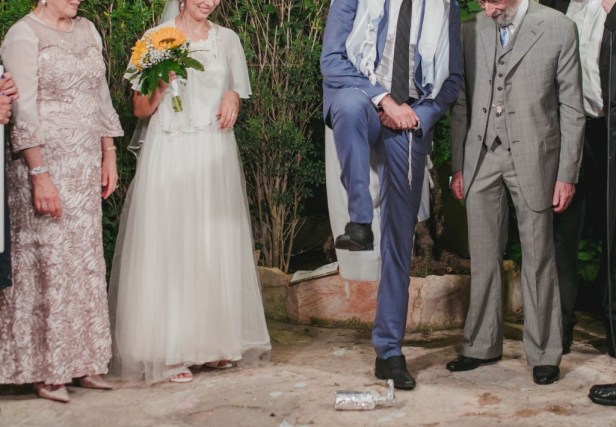
This is the grand finale! Everyone’s favorite part of a Jewish wedding. Traditionally, as the ending to a Jewish ceremony, the groom stomps on (and hopefully shatters) a glass. But why should the groom have all the fun? Some couples who opt for egalitarian ceremonies decide to have both the bride and groom smash glasses.
If you’re a same sex couple, the idea of having “the groom” smash the glass becomes irrelevant. Should both partners smash a glass, or just one? And, of course, if both partners decide they want to smash the glass, when should they do it? At the same time? One person after the other? It’s totally up to you. Personally, I think two simultaneous smashes work best.
 The Israeli Wedding